It's been awhile but the Twins can finally welcome back Kevin Slowey to their bullpen. Before going to the DL, Slowey had easily been the Twins most effective reliever, albeit in an extremely abbreviated sample. Since being sent on a rehab stint, the team had been trying to stretch him out in order to potential take Francisco Liriano's place in the rotation. Of course, we all know how Liriano has delayed those plans.
Should Liriano falter again of course, that could put Slowey right back on track to rejoin the rotation. In the meantime, the team will utilize him out of the bullpen where he's been solid. In order to make room for Slowey, the team has optioned waiver pickup Dusty Hughes to AAA.
Showing posts with label Francisco Liriano. Show all posts
Showing posts with label Francisco Liriano. Show all posts
Saturday, May 7, 2011

Wednesday, May 4, 2011
Francisco Liriano Throws No Hitter
Well, that was unexpected.
Off to a terrible start to his 2011 season, and with his back against the wall and his job rumored to be on the line, Francisco Liriano responded last night by throwing the first no-hitter of the 2011 season.
One of baseballs best pitchers during the 2010 season, I had fully expected Liriano to take yet another step forward in the eyes of fans around the country this year. Instead, he arrived to spring training reportedly not having followed his off season conditioning program, and has been a mess since spring training. His velocity was down, he wasn't missing bats like he has throughout his career and his sometimes spotty command had deteriorated to the level of abysmal.
Off to a terrible start to his 2011 season, and with his back against the wall and his job rumored to be on the line, Francisco Liriano responded last night by throwing the first no-hitter of the 2011 season.
One of baseballs best pitchers during the 2010 season, I had fully expected Liriano to take yet another step forward in the eyes of fans around the country this year. Instead, he arrived to spring training reportedly not having followed his off season conditioning program, and has been a mess since spring training. His velocity was down, he wasn't missing bats like he has throughout his career and his sometimes spotty command had deteriorated to the level of abysmal.
Saturday, April 30, 2011
Twins Power Outage
The Twins slow start is among the more surprising storylines to the start of the season. This is a club that has won the AL Central six times in the last ten years and never finished lower than third place (2005 and 2007) during that same period. To put it mildly, the Twins have been about as wildly successful as any club can be (excluding the post season). However, the Twins find themselves in an unusual position, last place.
It is still very early in the season, so normally I would feel it is too early to panic. On the other hand, everything seems to be going wrong for the club. Franchise player, superstar catcher Joe Mauer is on the disabled list with “leg weakness”, an absolutely terrifying “condition” given he had knee surgery in the offseason and is signed to a hefty 184 million dollar deal that runs until 2018. Francisco Liriano is having a completely perplexing year pitching with 18 strike outs to 18 walks, 4 home runs and a downright awful ERA of 9.13. Finally Justin Morneau has started very slowly in April after having serious problems with a concussion last season. It just seems like a year where everything that can go wrong will go wrong for this organization.
Wednesday, April 13, 2011
Examining the Struggles of Francisco Liriano
My how one year can change things.
In April of 2010, I was penning a post entitled, Is Liriano Back? that examined his stuff early last year vs where it had been in 2008 and 2009. Twelve months and one phenomenal season later, it feels like he might be right back to square one.
When Francisco Liriano is going well, he's s strike thrower who induces one of the highest swing-and-miss rates in the game. He'll pair a 93-94 fastball with excellent arm-side run with a wipeout slider that darts and dives and a parachute changeup that fades hard from righties. The first and last would qualify as legitimate plus pitches, and the slider is plus-plus - one of his generations best.
In April of 2010, I was penning a post entitled, Is Liriano Back? that examined his stuff early last year vs where it had been in 2008 and 2009. Twelve months and one phenomenal season later, it feels like he might be right back to square one.
When Francisco Liriano is going well, he's s strike thrower who induces one of the highest swing-and-miss rates in the game. He'll pair a 93-94 fastball with excellent arm-side run with a wipeout slider that darts and dives and a parachute changeup that fades hard from righties. The first and last would qualify as legitimate plus pitches, and the slider is plus-plus - one of his generations best.
Saturday, February 5, 2011
Twins, Liriano Come To Terms, Avoid Arbitration
A little over a week ago I wrote that I was confident the Twins were working on an extension for team ace Francisco Liriano. Then a couple days ago we learned via Seth Stohs, that the Twins had decided to go year-to-year with Liriano. Today, it's official - the team and it's ace have come to an agreement on a one year, 4.3m contract, 200k less than my 4.5m estimate. It's the second arbitration contract where the team and player have met in the exact middle of their two proposals.
In signing Liriano to a one year deal instead of trying to extend their ace, the Twins are protecting themselves from the risk associated with a long-term deal for a pitcher with one of baseball's more violent deliveries. They're also subjecting themselves to a fairly substantial risk of having to pay more for an extension should Liriano remain healthy and equally or even more effective which his peripherals suggest is a strong possibility. There's also a chance that Liriano, knowing he's just one year from a possible massive free agent payout could opt to eschew negotiations until after the 2012 season and instead test free agency.
The signing leaves Delmon Young as the last remaining arbitration candidate for the Twins or any other AL Central team. I'll have updated payroll information for all five teams once that signing is complete.
Corey Ettinger is a proud contributor to both 612Sports.net and 312Sports.com. He also provides extensive analysis of the American League Central Division at his own blog, AL Central In Focus.
In signing Liriano to a one year deal instead of trying to extend their ace, the Twins are protecting themselves from the risk associated with a long-term deal for a pitcher with one of baseball's more violent deliveries. They're also subjecting themselves to a fairly substantial risk of having to pay more for an extension should Liriano remain healthy and equally or even more effective which his peripherals suggest is a strong possibility. There's also a chance that Liriano, knowing he's just one year from a possible massive free agent payout could opt to eschew negotiations until after the 2012 season and instead test free agency.
The signing leaves Delmon Young as the last remaining arbitration candidate for the Twins or any other AL Central team. I'll have updated payroll information for all five teams once that signing is complete.
Corey Ettinger is a proud contributor to both 612Sports.net and 312Sports.com. He also provides extensive analysis of the American League Central Division at his own blog, AL Central In Focus.
Thursday, February 3, 2011
Twins Decide To Go Year-To-Year With Liriano
Almost exactly one week ago I wrote about what a possible Liriano extension would look like saying,
"I've mentioned more than once that the Twins are likely working on an extension with Francisco Liriano as we speak..."
"I've mentioned more than once that the Twins are likely working on an extension with Francisco Liriano as we speak..."
Wednesday, January 26, 2011
Prognosticating A Liriano Extension
I've mentioned more than once that the Twins are likely working on an extension with Francisco Liriano (and quite likely Delmon Young) as we speak (ok, not as we speak, because you're reading this... but you know what I mean). It's only logical after all. In 2010 Liriano was one of baseball's best pitchers, and clearly the ace of the Twins staff. His velocity was back and once again he was making hitters look foolish, showing that he was nearly all the way back to his 2006 form.
Thursday, April 29, 2010
Is Liriano Back?
NOTE: This study utilizes stats from all four of Liriano's 2010 starts. It is worth noting that the pitcher he was in game one, looked precisely nothing like the pitcher he has been the past three starts. It is therefor possible that 25% of the data in use may not be representative of the pitcher we will see from this point on. Should that be the case, we can revisit this discussion at a later date. But given Liriano's up-and-down nature the past two seasons, I firmly believe that non-inclusion of that data would express bias, something I always seek to avoid.
In 2006, Francisco Liriano took baseball by storm, striking out almost 11 batters per nine innings, walking fewer than 2.5 per inning, and posting a huge 55% ground ball rate. It was fair to say that for 16 starts Liriano was not only the best pitcher on the Twins, a team that featured two time Cy Young winner Johan Santana, but probably the most dominant pitcher in baseball.
Of all the things a pitcher can do well, he did them all, and he did them all exceptionally well. His fastball was hard - 95.6mph on average, and it moved a ton, inducing ground balls by the bushel. His change up came fitted with a parachute, and faded hard from the swing of right handed batters.
But it was his slider that struck the most fear in opponents. It was, for lack of a better way of putting it, essentially unhittable. For the hitters unfortunate enough to find themselves in two strike counts, it was generally nothing more than a matter of time until they joined the chorus of batters making the long, slow walk back to the dugout wondering precisely where the ball they had just swung at had disappeared to.
Then one fateful evening, his world exploded at the exact same instant that the tendon in his left elbow did.
It would be a long time until Francisco Liriano would see a baseball field again. Despite front office and managerial declarations of a pitcher throwing "up to 96 free and easy...," a year and a half of rehab wasn't enough to get Liriano back. Instead, the Liriano who came back in 2008 was one who's formerly dominant slider was nowhere to be found. In his place was a pitcher who managed an average fastball velocity of just 90.9mph, a slider that lacked bite, and a change up that no longer twisted batters in knots.
But, given his reduced stuff, Liriano fared decently, particularly after returning from a demotion to AAA. He still averaged 7.93K/9 - which is above average, and a respectable 3.79BB/9. But his GB rate had fallen down to 41%. He was a shell of the pitcher he once was.
In 2009 though, the wheels came off. Liriano regained a little more velocity, back to 91.7 mph on his average fastball, but his command vanished. He struck out a few more at 8.03K/9, but his walk rate shot up to 4.28 and his ground ball rate fell to 40%. This time he was put on the disabled list with a "tired arm," but it was pretty clearly known that he was demoted because the formerly dominant pitcher was struggling mightily with his confidence. He simply didn't know what was wrong, and he didn't know how to fix it.
My how much one off season can change things.
Beginning this winter in the Dominican League and continuing into spring training, Liriano went on a 68.2 inning tour de force, striking out 97 while walking just 12. Impressive numbers by any stretch of the imagination, but also numbers compiled against questionable talent levels. I was skeptical to say the least. I've seen this song and dance before.
But after a shaky first game of the season in very cold game at Chicago, Liriano has been devastating once again. Suddenly the radar guns are popping - he's averaging 93.3 mph with his fastball. It's not the overpowering pitch that it used to be, but plenty hard to be sure. But can the Liriano who's dominated his past three outing while posting 23 consecutive scoreless innings continue his performance?
For this study we'll be doing things a tad differently than we did with our analysis' of Jake Peavy and Justin Verlander, because this situation is a bit more complicated.
Velocity Value/100 %Thrown
Fastball06: 94.7 0.13 43.6
The fastball still hasn't regained it's old velocity, but it's up 1.6 mph over last year, and creeping closer to it's old levels. Moreover, it's actually been more effective this year than it's ever been in the past, and at a 51.5% usage rate, he's going to it more than he did in 2006.
The two most important aspects of his fastball, aren't really about the speed though. He's also back to inducing a huge percentage of ground balls. /;l[p=In 2006, people generally overlooked his phenomenal 55.3% ground ball rate. As we noted earlier, that rate fell to a career worst 40.2% last year, but suddenly it's back up to 51.8% Not quite as strong as before, but more than enough to be well above average.
Where the increased velocity really makes itself apparent, is in the differential. The gap in speeds between Liriano's fastball and slider has gone up considerably, from 5.5 mph last year, to 9.3 mph this year, making it much more difficult to time.
The slider is actually MORE effective this year than it's ever been. At +6.38/100, it's actually been almost twice as effective as the pitch he threw in 2006. That's phenomenal. What's weird, he's throwing it softer than last year, as he's trimmed more than 2mph off the pitch, despite gaining about 1.6mph of velocity on his fastball compared to last year. He's throwing it almost four mph slower than 2006.
The change up is not nearly as dominant of a pitch as it used to be, but it remains effective, and he still uses it right around 18% of the time and the velocity is surprisingly consistent.
Ok, so we can begin to see how Liriano's stuff stacks up. In some cases better than 2006 (fastball/slider) and in others worse (change up/velocity). He's not throwing as hard, but he's remained extremely effective.
1) Liriano is inducing a lot swinging strikes - 10.7%, but that's actually the worst rate of his career. That said, it's still more than 2% above league average, which is a lot. 2006 Liriano induced swinging strikes on an outrageous 16.4% of his pitches, more than double league average. It was that ability to make guys swing at nothing but air that enabled him to strikeout upwards of 11 batters per inning.
The fact that his swing-and-miss rate hasn't improved (and has actually gotten ever so marginally worse) compared to last season suggests that we shouldn't be expecting a spike in strikeout rate. Indeed, with a strikeout rate of 8.36/9IP, we're seeing a pitcher who is striking out almost precisely as many batters as he has the past two seasons.
Summation: Liriano is getting fewer swinging strikes than ever before, and generally that means lower strikeout rates.
2) There is some reason to believe that everything I said in point one may be rendered moot. Despite getting fewer swinging strikes overall, Liriano is actually getting batters to swing at more pitches out of the zone than at any other point in his career.
At 31.9%, batters are chasing an enormous number of his pitches. This has always been a Liriano staple, as he's averaged 28.1% out-of-zone swings throughout his career.
BUT! Hitters are also making contact with those out-of-zone pitches more than ever before. In 2006 batters made contact with just 35.3% of pitches that left the zone. They swung a lot, and they almost always came up empty. This year he's getting hitters to chase more often at 30.2%, but they're also putting the bat on the ball more often than ever before at an impressive 55.0%.
What gives?
Summation: Liriano is getting hitters to chase more often, which usually means more strikeouts, but they're making contact more often too.
3) Liriano is throwing strikes. Of everything you will read in this article, nothing is more important than this piece of information. To realize why this is you must first understand everything above. Liriano never lost his ability to strike batters out, and while there mixed signals about why he's been successful, most show that his ability to strike batters out hasn't gotten definitively better.
What is happening now is that Liriano has regained his ability to hammer the strike zone, getting strike one on 62.7% of batters, his best rate ever. He's also throwing 66% strikes overall, his best rate since his 67% mark in 2006.
Simply put Liriano is attacking hitters again. He isn't nibbling. He isn't hiding his fastball. He's saying, "here it is, lets see what you can do with it." The answer thus far has been, 'nothing.'
Unfortunately we don't have PitchFX data from 2006, so we can't compare information from then to now. But we can at least look to see what, if any differences exist between his stuff last year, and his stuff this year. As always, I'll be posting the graphs next to each other to allow you to see the differences for yourself.

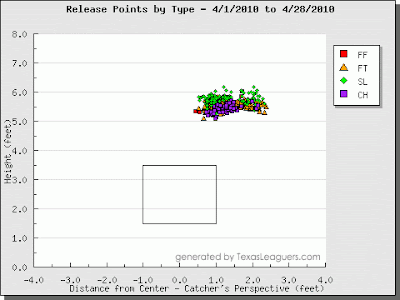
Liriano has never had a clear release point, but at least now, it's more consistently at the same level. The grouping is much, much tighter.


Here the improved movement on his pitches is readily apparent. He's getting significantly increased depth on all of his pitches, along with increased bite on his slider and fade on his change up and fastball.
On a pure stuff level, this Liriano is much better than the one we saw in 2009. Particularly with the slider and fastball.
On the slider he's gained 5.74in of drop and 1.74in of bite.
On the fastball he's gained 2.23in of drop and 0.26in of fade.
On the change he's gained 2.84in of drop and 0.36in of fade.
Essentially, he's doing everything you want to do with those three pitches quite a bit better than he did last year. The improved quality of those pitches, combined with the improved command we spoke of earlier leads one to believe that the change in Liriano is due to more than just luck and that, in all likelihood, this 'new Liriano,' is for real.
I'm not certain I have a definitive answer for you about our initial question, "is Francisco Liriano back?"
He's certainly better than he was at any point last year, and likely better than at any point in the past two years. And if you take out the first game from this season out of the equation, he is essentially as good as he was in 2006 (in terms of performance at least).
He's showing vastly improved command, he's getting more ground balls, and striking out more than at any point since his return from Tommy John. His pitches are legitimately much better than they were last year and hitters are chasing his pitches more than ever.
But he's also still not throwing as hard as he did in 2006 (though the gap has closed considerably), and he still hasn't matched the phenomenal ground ball, strikeout, or walk rates that he did.
So we can safely say that a much more effective Liriano is probably back. All that's left to be determined is how much better? Liriano should be pretty effectively able to answer that question over his next 3-4 starts.
Preface
In 2006, Francisco Liriano took baseball by storm, striking out almost 11 batters per nine innings, walking fewer than 2.5 per inning, and posting a huge 55% ground ball rate. It was fair to say that for 16 starts Liriano was not only the best pitcher on the Twins, a team that featured two time Cy Young winner Johan Santana, but probably the most dominant pitcher in baseball.
Of all the things a pitcher can do well, he did them all, and he did them all exceptionally well. His fastball was hard - 95.6mph on average, and it moved a ton, inducing ground balls by the bushel. His change up came fitted with a parachute, and faded hard from the swing of right handed batters.
But it was his slider that struck the most fear in opponents. It was, for lack of a better way of putting it, essentially unhittable. For the hitters unfortunate enough to find themselves in two strike counts, it was generally nothing more than a matter of time until they joined the chorus of batters making the long, slow walk back to the dugout wondering precisely where the ball they had just swung at had disappeared to.
Then one fateful evening, his world exploded at the exact same instant that the tendon in his left elbow did.
It would be a long time until Francisco Liriano would see a baseball field again. Despite front office and managerial declarations of a pitcher throwing "up to 96 free and easy...," a year and a half of rehab wasn't enough to get Liriano back. Instead, the Liriano who came back in 2008 was one who's formerly dominant slider was nowhere to be found. In his place was a pitcher who managed an average fastball velocity of just 90.9mph, a slider that lacked bite, and a change up that no longer twisted batters in knots.
But, given his reduced stuff, Liriano fared decently, particularly after returning from a demotion to AAA. He still averaged 7.93K/9 - which is above average, and a respectable 3.79BB/9. But his GB rate had fallen down to 41%. He was a shell of the pitcher he once was.
In 2009 though, the wheels came off. Liriano regained a little more velocity, back to 91.7 mph on his average fastball, but his command vanished. He struck out a few more at 8.03K/9, but his walk rate shot up to 4.28 and his ground ball rate fell to 40%. This time he was put on the disabled list with a "tired arm," but it was pretty clearly known that he was demoted because the formerly dominant pitcher was struggling mightily with his confidence. He simply didn't know what was wrong, and he didn't know how to fix it.
My how much one off season can change things.
Beginning this winter in the Dominican League and continuing into spring training, Liriano went on a 68.2 inning tour de force, striking out 97 while walking just 12. Impressive numbers by any stretch of the imagination, but also numbers compiled against questionable talent levels. I was skeptical to say the least. I've seen this song and dance before.
But after a shaky first game of the season in very cold game at Chicago, Liriano has been devastating once again. Suddenly the radar guns are popping - he's averaging 93.3 mph with his fastball. It's not the overpowering pitch that it used to be, but plenty hard to be sure. But can the Liriano who's dominated his past three outing while posting 23 consecutive scoreless innings continue his performance?
For this study we'll be doing things a tad differently than we did with our analysis' of Jake Peavy and Justin Verlander, because this situation is a bit more complicated.
Pitch Data
Velocity Value/100 %Thrown
Fastball06: 94.7 0.13 43.6
Fastball09: 91.7 -1.99 56.3
Fastball10: 93.3 1.10 51.5
Slider06: 87.8 3.47 37.6Slider09: 86.2 1.38 26.7
Slider10: 84.0 6.38 31.2
Changeup06: 83.5 2.82 18.7Changeup09: 84.7 0.91 16.9
Changeup10: 84.4 0.44 17.3The fastball still hasn't regained it's old velocity, but it's up 1.6 mph over last year, and creeping closer to it's old levels. Moreover, it's actually been more effective this year than it's ever been in the past, and at a 51.5% usage rate, he's going to it more than he did in 2006.
The two most important aspects of his fastball, aren't really about the speed though. He's also back to inducing a huge percentage of ground balls. /;l[p=In 2006, people generally overlooked his phenomenal 55.3% ground ball rate. As we noted earlier, that rate fell to a career worst 40.2% last year, but suddenly it's back up to 51.8% Not quite as strong as before, but more than enough to be well above average.
Where the increased velocity really makes itself apparent, is in the differential. The gap in speeds between Liriano's fastball and slider has gone up considerably, from 5.5 mph last year, to 9.3 mph this year, making it much more difficult to time.
The slider is actually MORE effective this year than it's ever been. At +6.38/100, it's actually been almost twice as effective as the pitch he threw in 2006. That's phenomenal. What's weird, he's throwing it softer than last year, as he's trimmed more than 2mph off the pitch, despite gaining about 1.6mph of velocity on his fastball compared to last year. He's throwing it almost four mph slower than 2006.
The change up is not nearly as dominant of a pitch as it used to be, but it remains effective, and he still uses it right around 18% of the time and the velocity is surprisingly consistent.
Ok, so we can begin to see how Liriano's stuff stacks up. In some cases better than 2006 (fastball/slider) and in others worse (change up/velocity). He's not throwing as hard, but he's remained extremely effective.
Swing Data
1) Liriano is inducing a lot swinging strikes - 10.7%, but that's actually the worst rate of his career. That said, it's still more than 2% above league average, which is a lot. 2006 Liriano induced swinging strikes on an outrageous 16.4% of his pitches, more than double league average. It was that ability to make guys swing at nothing but air that enabled him to strikeout upwards of 11 batters per inning.
The fact that his swing-and-miss rate hasn't improved (and has actually gotten ever so marginally worse) compared to last season suggests that we shouldn't be expecting a spike in strikeout rate. Indeed, with a strikeout rate of 8.36/9IP, we're seeing a pitcher who is striking out almost precisely as many batters as he has the past two seasons.
Summation: Liriano is getting fewer swinging strikes than ever before, and generally that means lower strikeout rates.
2) There is some reason to believe that everything I said in point one may be rendered moot. Despite getting fewer swinging strikes overall, Liriano is actually getting batters to swing at more pitches out of the zone than at any other point in his career.
At 31.9%, batters are chasing an enormous number of his pitches. This has always been a Liriano staple, as he's averaged 28.1% out-of-zone swings throughout his career.
BUT! Hitters are also making contact with those out-of-zone pitches more than ever before. In 2006 batters made contact with just 35.3% of pitches that left the zone. They swung a lot, and they almost always came up empty. This year he's getting hitters to chase more often at 30.2%, but they're also putting the bat on the ball more often than ever before at an impressive 55.0%.
What gives?
Summation: Liriano is getting hitters to chase more often, which usually means more strikeouts, but they're making contact more often too.
3) Liriano is throwing strikes. Of everything you will read in this article, nothing is more important than this piece of information. To realize why this is you must first understand everything above. Liriano never lost his ability to strike batters out, and while there mixed signals about why he's been successful, most show that his ability to strike batters out hasn't gotten definitively better.
What is happening now is that Liriano has regained his ability to hammer the strike zone, getting strike one on 62.7% of batters, his best rate ever. He's also throwing 66% strikes overall, his best rate since his 67% mark in 2006.
Simply put Liriano is attacking hitters again. He isn't nibbling. He isn't hiding his fastball. He's saying, "here it is, lets see what you can do with it." The answer thus far has been, 'nothing.'
PitchFX Data
Unfortunately we don't have PitchFX data from 2006, so we can't compare information from then to now. But we can at least look to see what, if any differences exist between his stuff last year, and his stuff this year. As always, I'll be posting the graphs next to each other to allow you to see the differences for yourself.


Liriano has never had a clear release point, but at least now, it's more consistently at the same level. The grouping is much, much tighter.
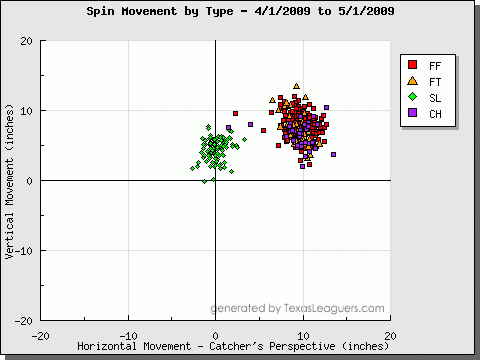

Here the improved movement on his pitches is readily apparent. He's getting significantly increased depth on all of his pitches, along with increased bite on his slider and fade on his change up and fastball.
On a pure stuff level, this Liriano is much better than the one we saw in 2009. Particularly with the slider and fastball.
On the slider he's gained 5.74in of drop and 1.74in of bite.
On the fastball he's gained 2.23in of drop and 0.26in of fade.
On the change he's gained 2.84in of drop and 0.36in of fade.
Essentially, he's doing everything you want to do with those three pitches quite a bit better than he did last year. The improved quality of those pitches, combined with the improved command we spoke of earlier leads one to believe that the change in Liriano is due to more than just luck and that, in all likelihood, this 'new Liriano,' is for real.
Conclusion
I'm not certain I have a definitive answer for you about our initial question, "is Francisco Liriano back?"
He's certainly better than he was at any point last year, and likely better than at any point in the past two years. And if you take out the first game from this season out of the equation, he is essentially as good as he was in 2006 (in terms of performance at least).
He's showing vastly improved command, he's getting more ground balls, and striking out more than at any point since his return from Tommy John. His pitches are legitimately much better than they were last year and hitters are chasing his pitches more than ever.
But he's also still not throwing as hard as he did in 2006 (though the gap has closed considerably), and he still hasn't matched the phenomenal ground ball, strikeout, or walk rates that he did.
So we can safely say that a much more effective Liriano is probably back. All that's left to be determined is how much better? Liriano should be pretty effectively able to answer that question over his next 3-4 starts.
Sunday, April 18, 2010
Nick Blackburn Dealing With Shoulder Pain
After exiting yesterday's 6-5 Twins win in the 5th inning with the score tied and just 76 pitches thrown, Twins starter Nick Blackburn told pitching coach Rick Anderson that his shoulder was hurting too much to go out again. Blackburn missed time this spring with knee soreness issues that he's been battling for the past couple seasons.
The Twins faced a litany of injuries to their starting staff in 2009 with Scott Baker, Kevin Slowey, Glen Perkins, and Francisco Liriano all missing a fair number of starts. Losing Blackburn who has been a rotation stalwart would certainly hurt. While the Twins could move Brian Duensing into the rotation if Blackburn indeed did need a trip to the DL, it would further exaserbate the issues their bullpen is currently facing.
Just today the Twins officially placed Jose Mijares on the 15 day disabled list where he'll join Clay Condrey and Joe Nathan. Pat Neshek could be headed there soon as well if the cortisone shot he received can't stop the pain in his middle finger. The Twins played with just five relievers today, but rookie Alex Burnett should be up by today to add depth. Burnett was demoted just a couple days ago after a pair of strong outings.
According to Star Tribune reporter Kelsie Smith;
"The starter said he deals with this particular shoulder pain often, that it comes and goes and that team doctors told him it is not concerning."
I've certainly never heard of it, and I don't recall it ever knocking him out of a game in the past. So saying that he deals with it all the time strikes me as disingenuous at best. Clearly this is something beyond the norm and could account for why Blackburn, a ground ball pitcher throughout his career has already given up six home runs in just three outings.
It's not quite time to push the panic button in Minnesota yet, but if Blackburn misses any serious amount of time, it might be. They're certainly having their depth tested early.
The Twins faced a litany of injuries to their starting staff in 2009 with Scott Baker, Kevin Slowey, Glen Perkins, and Francisco Liriano all missing a fair number of starts. Losing Blackburn who has been a rotation stalwart would certainly hurt. While the Twins could move Brian Duensing into the rotation if Blackburn indeed did need a trip to the DL, it would further exaserbate the issues their bullpen is currently facing.
Just today the Twins officially placed Jose Mijares on the 15 day disabled list where he'll join Clay Condrey and Joe Nathan. Pat Neshek could be headed there soon as well if the cortisone shot he received can't stop the pain in his middle finger. The Twins played with just five relievers today, but rookie Alex Burnett should be up by today to add depth. Burnett was demoted just a couple days ago after a pair of strong outings.
According to Star Tribune reporter Kelsie Smith;
"The starter said he deals with this particular shoulder pain often, that it comes and goes and that team doctors told him it is not concerning."
I've certainly never heard of it, and I don't recall it ever knocking him out of a game in the past. So saying that he deals with it all the time strikes me as disingenuous at best. Clearly this is something beyond the norm and could account for why Blackburn, a ground ball pitcher throughout his career has already given up six home runs in just three outings.
It's not quite time to push the panic button in Minnesota yet, but if Blackburn misses any serious amount of time, it might be. They're certainly having their depth tested early.
Monday, April 12, 2010
Twins Roundup: Week One
The Twins opened the season with two challenging road series, a four game set against defending AL West Champion Anaheim, and another against the rival White Sox and their upgraded pitching. All things considered, they did quite well by going 5-2.
The biggest question heading into the 2010 season for the Twins was how they'd hold up without closer Joe Nathan who was lost to season ending, and perhaps career threatening Tommy John Surgery. Into his vacated slid setup man Jon Rauch, and by all accounts, Rauch performed admirably. While he'll never be mistaken for Nathan with his 89-91 mph fastball, Rauch does what the Twins coaching staff wants all their pitchers to do - he pounds the zone. In doing just that he pitched four innings of relief, allowed just one run, and nailed down all four opportunities he was given.
Offensively the Twins battered the Angels pitching staff for 9 home runs in the first four games. In Chicago the much heralded pitching staff largely snuffed out the power, but the Twins continued to find ways to win, eeking out a 2-1 win behind ace Scott Baker on Saturday. The two most surprising, and promising, performances were by left fielder Delmon Young and shortstop J.J. Hardy, both of whom had things to prove for various reasons. Neither could've started much better than they did.
On the mound the Twins pitching certainly wasn't lights out, posting a 1.21 WHIP, but striking out less than 5 batters per inning. That's not a formula that can hold up over the long term, but thing should improve in that category. The most encouraging thing to see was Francisco Liriano, one more season removed from Tommy John Surgery throwing consistently at 94-95mph with the old bite back on his slider. He was a bit wild on opening day, walking five batters, but the old skill set seems to be back. If he can find a way to control it, the Twins could have the true ace they'll need to make a deep push.
Heading into week two, the Twins are going to be opening up brand new Target Field with a three game set against the Boston Red Sox and they'll have tough pitching matchups against Jon Lester and John Lackey to contend with. The Twins are a team that is going to hit, and if Jon Rauch can stabilize the back end of the bullpen enough to protect most leads, and the starting staff can hold up, the Twins will certainly be there at the end of 2010.
The biggest question heading into the 2010 season for the Twins was how they'd hold up without closer Joe Nathan who was lost to season ending, and perhaps career threatening Tommy John Surgery. Into his vacated slid setup man Jon Rauch, and by all accounts, Rauch performed admirably. While he'll never be mistaken for Nathan with his 89-91 mph fastball, Rauch does what the Twins coaching staff wants all their pitchers to do - he pounds the zone. In doing just that he pitched four innings of relief, allowed just one run, and nailed down all four opportunities he was given.
Offensively the Twins battered the Angels pitching staff for 9 home runs in the first four games. In Chicago the much heralded pitching staff largely snuffed out the power, but the Twins continued to find ways to win, eeking out a 2-1 win behind ace Scott Baker on Saturday. The two most surprising, and promising, performances were by left fielder Delmon Young and shortstop J.J. Hardy, both of whom had things to prove for various reasons. Neither could've started much better than they did.
On the mound the Twins pitching certainly wasn't lights out, posting a 1.21 WHIP, but striking out less than 5 batters per inning. That's not a formula that can hold up over the long term, but thing should improve in that category. The most encouraging thing to see was Francisco Liriano, one more season removed from Tommy John Surgery throwing consistently at 94-95mph with the old bite back on his slider. He was a bit wild on opening day, walking five batters, but the old skill set seems to be back. If he can find a way to control it, the Twins could have the true ace they'll need to make a deep push.
Heading into week two, the Twins are going to be opening up brand new Target Field with a three game set against the Boston Red Sox and they'll have tough pitching matchups against Jon Lester and John Lackey to contend with. The Twins are a team that is going to hit, and if Jon Rauch can stabilize the back end of the bullpen enough to protect most leads, and the starting staff can hold up, the Twins will certainly be there at the end of 2010.
Friday, April 2, 2010
Bounce Back Players
In the race for AL Central supremacy, the fate of the three front runners - the Twins, Tigers, and White Sox - could very likely rest on the shoulders of a handful of players looking to come back strong. Today we'll examine which players fans of those team should expect to come back, and which are likely to disappoint.
Tigers
Magglio Ordonez: Ordonez was hardly useless last year, posting a solid .804 OPS. But for a guy who has a career OPS of of .884, that's not quite what Tigers fans have come to expect. The primary reason for the decline a big decline in the power department. After raking 55 extra base hits in 2009, he had just 35 last year - just nine of which were home runs. More troubling still, it wasn't the first year of decline - he had an absurd 82 extra base hits in 2008.
For a guy who will be 36 this year, the days of posting MVP numbers are likely behind Magglio, but there is plenty of evidence to suggest that he should rebound nicely this year and be more like the hitter he was in 2008, than the guy he was in 2009.
First and most importantly, while there was a significant decline in power production, there wasn't much change in Ordonez' ancillary numbers. His strikeout, walks, and line drive rates remain essentially unchanged. The one huge difference was in ground ball rate. Magglio, as is the case with most power hitters, has always been an extreme fly ball hitter. Last year that changed radically as his ground ball rate shot up to 51% from a career rate of 44.2%.
To me, that suggests a mechanical issue, and mechanical issues can be fixed with good coaching. I'd be far more concerned if we were seeing declines in the other numbers, as that would suggest lower bat speed, or declining ability to recognize and react to pitches. We don't see any of that. With a fine spring training under his belt where he mashed six extra base hits along with a pair of homers in just 51 at-bats, I'd expect Magglio to produce just fine in the middle of the Tigers order and provide a lot more run producing power to a lineup I think will surprise a lot of people in 2009.
Dontrelle Willis: After being left by the side of the road for garbage removal, Willis has seemingly risen from the dead to reclaim a spot in the Tigers rotation. The Tigers front office clearly felt strong enough about Willis that they we're willing to trade Nate Robertson to the Marlins. Robertson having plenty of his own issues and his own bloated contract obviously convolutes the impressiveness of Willis' feat, but given where he has been the last couple years, this should be seen as a very good sign.
When most people think of Willis, they tend to remember him as the dominant youngster he was with the Marlins back in the early part of the decade. The weird thing is that despite some gaudy ERA and W/L numbers, he was never really that terribly dominant. His fastball velocity at it's peak only averaged 90.5 mph, he only once topped 7 K/9, only once had a walk rate lower than 2.7 BB/9, and has only once had a ground ball rate over 50%. Of all the things pitchers generally need to do well in order to be successful, Willis hasn't really ever done any of them.
To me that means he was getting by on deception, whether it was the crazy leg kick or the weird 3/4, almost sidearm slot he used to throw with. Either way, hitters figured him out. When they did, it left a lot of people feeling confused, but really, there was never much to be confused by. Willis, was, and always has been, a pretty mediocre pitcher. The problem is that beginning in 2006, his walk rate began to deteriorate. It was somewhat steady at first, but his command fell off a cliff after joining the Tigers and since signing a huge contract with the team, he's made just 14 starts in two seasons, with a combined ERA over 8.00.
Things might be looking up for Willis and the Tigers however. Reports this spring are that Willis is throwing in the high 80's, which is just a bit lower than his career norms, and that he's gotten his command issues under control enough to be useful.
I however, remain highly skeptical. While reports of better command are nice, 12 walks in 19.1 spring innings against just 13 strikeouts doesn't bode well at all. While one should never look into spring training innings much at all, in Willis' case, you almost have to. One thing Willis has done a phenomenal job of however, is keeping the ball on the ground, getting 2 ground ball outs for every fly out this spring.
On a personal level, I want Willis to succeed. I've followed his decline pretty closely since his days with the Marlins and remember what a great ambassador for the game he seemed to be. Willis was the sort of player it was difficult to root against, and that remains true to this day. He's always struck me as a pretty humble guy, and to read some of the quotes from him when he was down was just sad. Unfortunately, I also have to listen to my common sense, and on the whole, I don't expect much from Willis this year and I'm afraid he'll be out of the rotation within a month.
White Sox
Alex Rios: Earlier, in discussing Magglio Ordonez, I pointed out how I would be concerned to see a player posting declining numbers in their strikeout, walk, and line drive rates. I used that to illustrate why I expected Magglio Ordonez to have a return to normalcy this season. Well, it is for precisely those same reasons that I am more concerned about Rios.
Even after wasting his first two seasons with OPS numbers in the low .700s and a disastrous 2009, Rios has been a career .289/.330/.444 hitter. He posted back-to-back .850+ OPS seasons in 2006 and 2007 and a solid if unspectacular .798 in 2008. So even with three really ugly seasons in his short career, he's been at least a league average offensive player.
That said, all the trend lines for Rios are going the wrong way. His ISO (isolated power) has decline in four straight seasons, and his strikeout and walk rates have trended the wrong way for three straight seasons. His line drive rate, pretty consistently at around 20% for his career nose dived to 16.4% last year.
Those numbers definitely suggest a player who's skill set is diminishing. He simply doesn't seem to be seeing the ball as well, and is no longer able to square it up the way he once was. There is evidence that he may have been able to mask his decline to some extent in 2008 by posting a .337 BABIP, his highest mark ever and 12 points above his career average, though the .798 OPS should've provided some evidence to his lessening skills. Last year however, he was definitely the victim of some bad luck as his BABIP was just .273.
While the trend lines suggest that his decline is real, and his BABIP last year suggests he was unlucky, I personally tend to trust the trend lines more. Even if Rios' BABIP last year was in like with his career average, of .319, which would've added a substantial 36 points to his batting average, 2009 still would've ranked as his worst season since 2005.
I'm confident that Rios will rebound to some extent in 2010, but I'm also confident that his days of being a .800 OPS hitter are likely over. Given the contact commitment the White Sox are on the hook for with him, that could be a very bad thing indeed. Generally speaking Kenny Williams is one of the savviest GMs in baseball, but I think he may have miscalculated this move. Hopefully for the White Sox faithful, I'm wrong.
Jake Peavy: Clearly this is less a conversation about some kind of decline that Peavy had, and more about his return from injury, but there is one possible sign of decline in Peavy too. Most prominently I'm referring to his walk rate. While they're hardly been bad the past couple of years, they aren't what they once were either. From 2004 through 2007, a stretch of four seasons, the WORST walk rate Peavy ever posted was 2.87 BB/9.
While nit-picking on a slightly worse walk rate than normal might be considered reaching, it is worth being aware of. We should also take note of slight decreases in velocity the past couple of seasons. While velocity tends to be over-valued by fans and research shows the difference between fastballs with equal movement and location tend to be almost exactly as effective regardless of the speed with which the pitch is thrown - the exceptions being above 96 mph or below 85 mph - declining velocity does frequently (though hardly always) correlate with declining overall skills.
The good news for Sox fans is that Peavy was dominant in his return last fall. While the strikeout rates were predictably off just a little bit, the walk rate looked good and he kept the ball in the ballpark nicely. He's had some command issues this spring, and while there has been some hand wringing in the media, I'm inclined to believe it's nothing.
I expect big things from Peavy this year, and if he can return to his Cy Young winning form, he could just lead the White Sox to the playoffs.
Carlos Quentin: Much like Peavy, Quentin struggled through an injury plagued 2009 season, but when he's on and when he's healthy he's be a legitimate force in the middle of any lineup. Given the trade of Jim Thome and the off season departure of Jermaine Dye, Quentin will be expected to provide much of the punch in the middle of the Chicago offense.
If Quentin can provide anything like the .965 OPS he did in 2008, it's going to make the White Sox a much tougher team to contend with. Standing in Quentin's way will be an off walk rate, historically poor line drive rates, and increasing fly ball rates.
High fly ball rates and poor line drive rates will pretty much always coincide with below normal BABIP numbers, and Quentin is no exception. If his career BABIP of .255 seems freakishly low, that's because it is. It also means his BABIP of .282 in 2008 suggested he was a bit lucky that year, and a bit unlucky last season. I'm expecting something in the neighborhood of a .860-.880 OPS this year.
Twins
J.J. Hardy: Hardy was acquired by the Twins in a trade for Carlos Gomez. It was a good trade in the sense that each team was trading from a position of strength to fill a position of weakness. In the Twins case, they had Denard Span to take over for the offensively challenged Gomez, and the Brewers had top prospect Alcides Escobar ready to take over for declining incumbent Hardy.
Like Rios, who I discussed earlier in this post, Hardy has a lot of negative trend lines that don't bode well for future success. The strikeout rate has risen for three straight years to 20.5% this last year, and his line drive rate has fallen for three straight seasons to an almost impossibly low 13.9% last year. His power also fell off a cliff from a career high ISO of .195 in 2008 to .128 last year. Furthermore a study of his BABIP last year leads one to believe luck wasn't a huge factor last year as his .260 mark wasn't too far off his career .278.
If there was any sign of hope for Hardy last year it was that his walk rate was the best of his career. The Twins won't be relying Hardy to power their offense by any means, and right now it looks like he'll be slotted 7th or 8th in the order. All the same, Hardy was brought in with the intent of shoring up the incredibly weak offense the team received at shortstop and second base last year, and with a 5.1m payroll number, he'll be expected to provide something for the team with the bat.
Thankfully to say, much of Hardy's value is tied up in the fact that he's a plus defender at a defense first position, and that did not take a step backward last season. It'll be interesting to see how the move to the AL effects Hardy - generally that doesn't bode well for the player - if that trend holds true and Hardy isn't able to regain his old offensive form, Bill Smith will have missed once again in a trade.
Everything having been said, I'm not too high on Hardy and I don't expect much of a bounce back season, though he shouldn't be quite as bad as last year. If he can give the Twins an OPS around .750, Twins fans should consider themselves lucky.
Francisco Liriano: After what can only be described as a dismal 2009, many Twins fans seemed ready to give up on Liriano. There was talk of moving him to the bullpen permanently, or trading him for whatever they could get. Thankfully for the Twins, that didn't happen. Instead Liriano headed off off to the Dominican Winter League and dominated. He then came to spring training and picked up where he left off. Between the Dominican League and the Cactus League he gave his teams 68.2 innings of shut-down baseball. In that span he struck out 97, walked 7, and allowed just two home runs.
Obviously those video game type numbers aren't going to carry over to the Majors, but the Twins and their fans have every reason to be excited. Perhaps most importantly, this is one of those situations where the numbers and the reports jive. Scouts have been saying that Liriano has regained more of his velocity, not all of it, but enough to make a difference. More importantly, his slider, once one of baseballs most devastating pitches, is breaking harder and deeper with more consistency than it has since 2006.
Right now Liriano is projected to be the Twins 5th starter but I have a feeling he's going to end up as their ace by the time May comes around. Either way, he should be significantly better than he was in 2009, and I think his downside might be his 2008 second half which was pretty solid in its own right. If Liriano can return to being a #1 or #2 - or even a #3 he's going to make a big difference in the outcome of the Twins 2010 season.
Tigers
Magglio Ordonez: Ordonez was hardly useless last year, posting a solid .804 OPS. But for a guy who has a career OPS of of .884, that's not quite what Tigers fans have come to expect. The primary reason for the decline a big decline in the power department. After raking 55 extra base hits in 2009, he had just 35 last year - just nine of which were home runs. More troubling still, it wasn't the first year of decline - he had an absurd 82 extra base hits in 2008.
For a guy who will be 36 this year, the days of posting MVP numbers are likely behind Magglio, but there is plenty of evidence to suggest that he should rebound nicely this year and be more like the hitter he was in 2008, than the guy he was in 2009.
First and most importantly, while there was a significant decline in power production, there wasn't much change in Ordonez' ancillary numbers. His strikeout, walks, and line drive rates remain essentially unchanged. The one huge difference was in ground ball rate. Magglio, as is the case with most power hitters, has always been an extreme fly ball hitter. Last year that changed radically as his ground ball rate shot up to 51% from a career rate of 44.2%.
To me, that suggests a mechanical issue, and mechanical issues can be fixed with good coaching. I'd be far more concerned if we were seeing declines in the other numbers, as that would suggest lower bat speed, or declining ability to recognize and react to pitches. We don't see any of that. With a fine spring training under his belt where he mashed six extra base hits along with a pair of homers in just 51 at-bats, I'd expect Magglio to produce just fine in the middle of the Tigers order and provide a lot more run producing power to a lineup I think will surprise a lot of people in 2009.
Dontrelle Willis: After being left by the side of the road for garbage removal, Willis has seemingly risen from the dead to reclaim a spot in the Tigers rotation. The Tigers front office clearly felt strong enough about Willis that they we're willing to trade Nate Robertson to the Marlins. Robertson having plenty of his own issues and his own bloated contract obviously convolutes the impressiveness of Willis' feat, but given where he has been the last couple years, this should be seen as a very good sign.
When most people think of Willis, they tend to remember him as the dominant youngster he was with the Marlins back in the early part of the decade. The weird thing is that despite some gaudy ERA and W/L numbers, he was never really that terribly dominant. His fastball velocity at it's peak only averaged 90.5 mph, he only once topped 7 K/9, only once had a walk rate lower than 2.7 BB/9, and has only once had a ground ball rate over 50%. Of all the things pitchers generally need to do well in order to be successful, Willis hasn't really ever done any of them.
To me that means he was getting by on deception, whether it was the crazy leg kick or the weird 3/4, almost sidearm slot he used to throw with. Either way, hitters figured him out. When they did, it left a lot of people feeling confused, but really, there was never much to be confused by. Willis, was, and always has been, a pretty mediocre pitcher. The problem is that beginning in 2006, his walk rate began to deteriorate. It was somewhat steady at first, but his command fell off a cliff after joining the Tigers and since signing a huge contract with the team, he's made just 14 starts in two seasons, with a combined ERA over 8.00.
Things might be looking up for Willis and the Tigers however. Reports this spring are that Willis is throwing in the high 80's, which is just a bit lower than his career norms, and that he's gotten his command issues under control enough to be useful.
I however, remain highly skeptical. While reports of better command are nice, 12 walks in 19.1 spring innings against just 13 strikeouts doesn't bode well at all. While one should never look into spring training innings much at all, in Willis' case, you almost have to. One thing Willis has done a phenomenal job of however, is keeping the ball on the ground, getting 2 ground ball outs for every fly out this spring.
On a personal level, I want Willis to succeed. I've followed his decline pretty closely since his days with the Marlins and remember what a great ambassador for the game he seemed to be. Willis was the sort of player it was difficult to root against, and that remains true to this day. He's always struck me as a pretty humble guy, and to read some of the quotes from him when he was down was just sad. Unfortunately, I also have to listen to my common sense, and on the whole, I don't expect much from Willis this year and I'm afraid he'll be out of the rotation within a month.
White Sox
Alex Rios: Earlier, in discussing Magglio Ordonez, I pointed out how I would be concerned to see a player posting declining numbers in their strikeout, walk, and line drive rates. I used that to illustrate why I expected Magglio Ordonez to have a return to normalcy this season. Well, it is for precisely those same reasons that I am more concerned about Rios.
Even after wasting his first two seasons with OPS numbers in the low .700s and a disastrous 2009, Rios has been a career .289/.330/.444 hitter. He posted back-to-back .850+ OPS seasons in 2006 and 2007 and a solid if unspectacular .798 in 2008. So even with three really ugly seasons in his short career, he's been at least a league average offensive player.
That said, all the trend lines for Rios are going the wrong way. His ISO (isolated power) has decline in four straight seasons, and his strikeout and walk rates have trended the wrong way for three straight seasons. His line drive rate, pretty consistently at around 20% for his career nose dived to 16.4% last year.
Those numbers definitely suggest a player who's skill set is diminishing. He simply doesn't seem to be seeing the ball as well, and is no longer able to square it up the way he once was. There is evidence that he may have been able to mask his decline to some extent in 2008 by posting a .337 BABIP, his highest mark ever and 12 points above his career average, though the .798 OPS should've provided some evidence to his lessening skills. Last year however, he was definitely the victim of some bad luck as his BABIP was just .273.
While the trend lines suggest that his decline is real, and his BABIP last year suggests he was unlucky, I personally tend to trust the trend lines more. Even if Rios' BABIP last year was in like with his career average, of .319, which would've added a substantial 36 points to his batting average, 2009 still would've ranked as his worst season since 2005.
I'm confident that Rios will rebound to some extent in 2010, but I'm also confident that his days of being a .800 OPS hitter are likely over. Given the contact commitment the White Sox are on the hook for with him, that could be a very bad thing indeed. Generally speaking Kenny Williams is one of the savviest GMs in baseball, but I think he may have miscalculated this move. Hopefully for the White Sox faithful, I'm wrong.
Jake Peavy: Clearly this is less a conversation about some kind of decline that Peavy had, and more about his return from injury, but there is one possible sign of decline in Peavy too. Most prominently I'm referring to his walk rate. While they're hardly been bad the past couple of years, they aren't what they once were either. From 2004 through 2007, a stretch of four seasons, the WORST walk rate Peavy ever posted was 2.87 BB/9.
While nit-picking on a slightly worse walk rate than normal might be considered reaching, it is worth being aware of. We should also take note of slight decreases in velocity the past couple of seasons. While velocity tends to be over-valued by fans and research shows the difference between fastballs with equal movement and location tend to be almost exactly as effective regardless of the speed with which the pitch is thrown - the exceptions being above 96 mph or below 85 mph - declining velocity does frequently (though hardly always) correlate with declining overall skills.
The good news for Sox fans is that Peavy was dominant in his return last fall. While the strikeout rates were predictably off just a little bit, the walk rate looked good and he kept the ball in the ballpark nicely. He's had some command issues this spring, and while there has been some hand wringing in the media, I'm inclined to believe it's nothing.
I expect big things from Peavy this year, and if he can return to his Cy Young winning form, he could just lead the White Sox to the playoffs.
Carlos Quentin: Much like Peavy, Quentin struggled through an injury plagued 2009 season, but when he's on and when he's healthy he's be a legitimate force in the middle of any lineup. Given the trade of Jim Thome and the off season departure of Jermaine Dye, Quentin will be expected to provide much of the punch in the middle of the Chicago offense.
If Quentin can provide anything like the .965 OPS he did in 2008, it's going to make the White Sox a much tougher team to contend with. Standing in Quentin's way will be an off walk rate, historically poor line drive rates, and increasing fly ball rates.
High fly ball rates and poor line drive rates will pretty much always coincide with below normal BABIP numbers, and Quentin is no exception. If his career BABIP of .255 seems freakishly low, that's because it is. It also means his BABIP of .282 in 2008 suggested he was a bit lucky that year, and a bit unlucky last season. I'm expecting something in the neighborhood of a .860-.880 OPS this year.
Twins
J.J. Hardy: Hardy was acquired by the Twins in a trade for Carlos Gomez. It was a good trade in the sense that each team was trading from a position of strength to fill a position of weakness. In the Twins case, they had Denard Span to take over for the offensively challenged Gomez, and the Brewers had top prospect Alcides Escobar ready to take over for declining incumbent Hardy.
Like Rios, who I discussed earlier in this post, Hardy has a lot of negative trend lines that don't bode well for future success. The strikeout rate has risen for three straight years to 20.5% this last year, and his line drive rate has fallen for three straight seasons to an almost impossibly low 13.9% last year. His power also fell off a cliff from a career high ISO of .195 in 2008 to .128 last year. Furthermore a study of his BABIP last year leads one to believe luck wasn't a huge factor last year as his .260 mark wasn't too far off his career .278.
If there was any sign of hope for Hardy last year it was that his walk rate was the best of his career. The Twins won't be relying Hardy to power their offense by any means, and right now it looks like he'll be slotted 7th or 8th in the order. All the same, Hardy was brought in with the intent of shoring up the incredibly weak offense the team received at shortstop and second base last year, and with a 5.1m payroll number, he'll be expected to provide something for the team with the bat.
Thankfully to say, much of Hardy's value is tied up in the fact that he's a plus defender at a defense first position, and that did not take a step backward last season. It'll be interesting to see how the move to the AL effects Hardy - generally that doesn't bode well for the player - if that trend holds true and Hardy isn't able to regain his old offensive form, Bill Smith will have missed once again in a trade.
Everything having been said, I'm not too high on Hardy and I don't expect much of a bounce back season, though he shouldn't be quite as bad as last year. If he can give the Twins an OPS around .750, Twins fans should consider themselves lucky.
Francisco Liriano: After what can only be described as a dismal 2009, many Twins fans seemed ready to give up on Liriano. There was talk of moving him to the bullpen permanently, or trading him for whatever they could get. Thankfully for the Twins, that didn't happen. Instead Liriano headed off off to the Dominican Winter League and dominated. He then came to spring training and picked up where he left off. Between the Dominican League and the Cactus League he gave his teams 68.2 innings of shut-down baseball. In that span he struck out 97, walked 7, and allowed just two home runs.
Obviously those video game type numbers aren't going to carry over to the Majors, but the Twins and their fans have every reason to be excited. Perhaps most importantly, this is one of those situations where the numbers and the reports jive. Scouts have been saying that Liriano has regained more of his velocity, not all of it, but enough to make a difference. More importantly, his slider, once one of baseballs most devastating pitches, is breaking harder and deeper with more consistency than it has since 2006.
Right now Liriano is projected to be the Twins 5th starter but I have a feeling he's going to end up as their ace by the time May comes around. Either way, he should be significantly better than he was in 2009, and I think his downside might be his 2008 second half which was pretty solid in its own right. If Liriano can return to being a #1 or #2 - or even a #3 he's going to make a big difference in the outcome of the Twins 2010 season.
Subscribe to:
Posts (Atom)