Yesterday the Tigers and reliever Joel Zumaya decided to go under the knife to try to determine why he was still experiencing pain in his surgically repaired elbow a month after the pain first manifested itself. But for other AL Central teams dealing with injuries to key arms, the news is better as those pitchers are getting close to returning.
In Toledo White Sox starter Jake Peavy made the last of his scheduled rehab starts today and will rejoin the team tomorrow. Elsewhere, Twins stater-turned-reliever Kevin Slowey, and Indians starter Carlos Carrasco are all nearing returns.
Showing posts with label Jake Peavy. Show all posts
Showing posts with label Jake Peavy. Show all posts
Thursday, May 5, 2011

Saturday, April 9, 2011
Jake Peavy Makes First Rehab Start
At one point this spring it looked likely that White Sox starter Jake Peavy (can I call him a ace anymore?) looked as though he might be able to make a rather impressive return from his torn lat muscle. Initial estimates suggested that Peavy wouldn't be ready until early May at the soonest, but Peavy was trying to defy those expectations, and perhaps even looking at being ready for opening day.
Unfortunately after suffering shoulder soreness, later revealed diagnosed as tendinitis, his return date was once again pushed back. There was a small measure of controversy surrounding the diagnosis as Peavy had tried to pitch through it without alerting the team or it's medical staff to his pain. That's something that's become a disturbing tendency for some. While many appreciate Peavy's tough guy mentality, his willingness to pitch through too much pain, to the point of causing further injury has become a bother.
Unfortunately after suffering shoulder soreness, later revealed diagnosed as tendinitis, his return date was once again pushed back. There was a small measure of controversy surrounding the diagnosis as Peavy had tried to pitch through it without alerting the team or it's medical staff to his pain. That's something that's become a disturbing tendency for some. While many appreciate Peavy's tough guy mentality, his willingness to pitch through too much pain, to the point of causing further injury has become a bother.
Tuesday, March 8, 2011
AL Central Injury Updates
It seems like yesterday, but I haven't done an Injury Update since the 27th. Apologies for that.
- Grady Sizemore (Knee): Still no closer to returning from off season microfracture surgery at this point. It seems highly unlikely he opens the season.
- Trevor Crowe (Shoulder): Has been taking cortisone shots, but also remains doubtful for the start of the season.
- Michael Brantley (legs): Has been experiencing fatigue and pain in legs. Will take a few games off.
- Shin-Soo Choo: (Elbow) He's been experiencing some discomfort but as of now isn't expected to miss time.
- Jared Goedert (Oblique): Is expected to miss at least two weeks. Was a long-shot candidate for a backup infield position. Will open the season in AAA.
- Jason Donald (Hand): He was hit in the hand by a pitch. X-Rays negative. Should be back playing within a week.
- Anthony Reyes (Elbow): Threw a 36-pitch bullpen without any reported issues.
Indians:
- Grady Sizemore (Knee): Still no closer to returning from off season microfracture surgery at this point. It seems highly unlikely he opens the season.
- Trevor Crowe (Shoulder): Has been taking cortisone shots, but also remains doubtful for the start of the season.
- Michael Brantley (legs): Has been experiencing fatigue and pain in legs. Will take a few games off.
- Shin-Soo Choo: (Elbow) He's been experiencing some discomfort but as of now isn't expected to miss time.
- Jared Goedert (Oblique): Is expected to miss at least two weeks. Was a long-shot candidate for a backup infield position. Will open the season in AAA.
- Jason Donald (Hand): He was hit in the hand by a pitch. X-Rays negative. Should be back playing within a week.
- Anthony Reyes (Elbow): Threw a 36-pitch bullpen without any reported issues.
Saturday, January 22, 2011
White Sox Claim Philip Humber
Philip Humber is becoming quite the AL Central traveling man. After stops in Minnesota and Kansas City, he's now a member of the White Sox (after a brief one month stop with the A's this winter). It's hard to believe, but Humber was once an immensely talented prospect who was the 3rd overall pick in the 2004 draft. Tommy John surgery has long since diminished those skills, but he's hung around and will now be joining his 5th Major League organization.
Monday, December 20, 2010
Jake Peavy is Looking Good?
At this point of the year it's really nothing more than speculation and as such, should be taken with a ten pound bag of salt, but it's certainly not a BAD thing that White Sox pitching coach Don Cooper is saying,
Of course, the one thing you wont hear White Sox personnel say is that regardless of when Peavy makes it back, it's no sure thing that he'll be able to contribute at the level he did during his Padre days. Injuries unfortunately have been decidedly unkind to Peavy the past few years and as we saw last year, it took Peavy some time to regain his form after a terrible start to the season.
It's possible that the team could look to sign someone else to fill in for Peavy if they would prefer to have Sale open the season - Freddy Garcia is an oft mentioned candidate - but given the teams financial situation that would seem to be a difficult task to accomplish.
"I really didn't think he would be right there. I thought it would be slower, but he hopped right into it and has a chance to be ready."That of course, is in regard to Sox ace Jake Peavy's rehab from a torn lat muscle. I'm not an injury expect by any means (nor have I ever played one on TV) but obviously an early return from Peavy would be in the White Sox best interests. The team is long on talent in the rotation, but frighteningly thin in terms of depth, with Chris Sale expected to open the season in the rotation in Peavy's absence.
Of course, the one thing you wont hear White Sox personnel say is that regardless of when Peavy makes it back, it's no sure thing that he'll be able to contribute at the level he did during his Padre days. Injuries unfortunately have been decidedly unkind to Peavy the past few years and as we saw last year, it took Peavy some time to regain his form after a terrible start to the season.
It's possible that the team could look to sign someone else to fill in for Peavy if they would prefer to have Sale open the season - Freddy Garcia is an oft mentioned candidate - but given the teams financial situation that would seem to be a difficult task to accomplish.
Wednesday, December 8, 2010
White Sox Bring Back Paul Konerko
It had been apparent throughout the off season that the White Sox wanted to retain their free agent first baseman Paul Konerko. General Manager Kenny Williams wasn't shy about this, nor was team Owner and President Jerry Reinsdorf, with whom Konerko is said to share a very good relationship. Even so, everyone knew that payroll was going to be tight and that the team had other holes to fill. But today, with the other holes having been filled - notably at DH with the acquisition of Adam Dunn - the Sox resigned Konerko.
Good relationship with management and ownership aside, this wasn't an easy sign and Kenny himself said that this nearly didn't happen. Williams has put his club in a tough fiscal position with a number of expensive contracts on the books for a lot of questionable players, be it Alex Rios, Jake Peavy, Mark Teahan, or until recently, Scott Linebrink. Even with back-loading the contracts recently given out to Dunn and AJ Pierzynski, non-tendering long-time closer Bobby Jenks, and trading off 2m of Linebrink's 2011 salary to the Braves - my payroll estimate still put the Sox at 112.2m - already a team record. So to bring back Konerko the team needed some help from ownership, and they obliged in the form of a three year, $37.5m deal that will pay Konerko 12m in 2011 and 2012, and 13.5m in 2013.
In Konerko, the White Sox have signed more than just a very good hitter, they secured a player who should wind up in their teams Hall-of-Fame after spending the past 11 seasons in white and black. Aside from that however, this is a risky signing. The Sox are now committed for the next three seasons to a player in Dunn who should be kept as far away from a defensive position as possible, and another in Konerko who has generally ranked around league average at first, but whom all three of the major advanced defensive metrics rated his 2010 very poorly. His +/- was -17, his defensive runs saved (DRS) was -18, and his UZR/150 was -14.7.
It's perfectly possible that this was an aberration - defensive metrics can be hit-and-miss sometimes - but it's equally possible that Konerko has begun that defensive slide that all players eventually do. Given that he was 34 last year, that would hardly be surprising. If so, the White Sox will be carrying two players who are both better suited for DH roles, and they'll be ding so for the next three years. That's not a particularly heart-warming prospect.
It's also unlikely that Konerko's offense of 2010 will be replicated. That's partly because he's past his prime, and partly because, well, he'd never been THAT good before. If Konerko hasn't found the fountain of youth as I expect, it's far more likely that he'll perform closer to his 2009 and 2007 seasons where he posted OPS marks of .841 and .842. If we assume that his defensive decline is a fluke and he continues to perform offensively at past levels, lets say an .850 OPS, that would make Konerko a consistent 2.5 WAR sort of player.
Of course, that assumes a lot of things that are, in general, really difficult to project for an aging player. That said, we have a lot of history to look at to suggest that Konerko should be capable, at least offensively, of providing consistent production for the life of his deal. So for 37.5m dollars, the White Sox have not only locked up a solid everyday bat, they've locked up someone who, along with starter Mark Buehrle, has been the face of the Franchise for the past decade. And yes (as much as it pains me to admit it), there is some value in that which can't be measured purely by a players production statistics.
Kenny Williams still has some work to do - namely, trying to figure out who the four guys in his bullpen not named Matt Thornton and Sergio Santos are going to be. But, with some considerable help from ownership, he's accomplished his biggest goal - fortifying his lineup and bringing back a fan favorite and White Sox icon.
Good relationship with management and ownership aside, this wasn't an easy sign and Kenny himself said that this nearly didn't happen. Williams has put his club in a tough fiscal position with a number of expensive contracts on the books for a lot of questionable players, be it Alex Rios, Jake Peavy, Mark Teahan, or until recently, Scott Linebrink. Even with back-loading the contracts recently given out to Dunn and AJ Pierzynski, non-tendering long-time closer Bobby Jenks, and trading off 2m of Linebrink's 2011 salary to the Braves - my payroll estimate still put the Sox at 112.2m - already a team record. So to bring back Konerko the team needed some help from ownership, and they obliged in the form of a three year, $37.5m deal that will pay Konerko 12m in 2011 and 2012, and 13.5m in 2013.
In Konerko, the White Sox have signed more than just a very good hitter, they secured a player who should wind up in their teams Hall-of-Fame after spending the past 11 seasons in white and black. Aside from that however, this is a risky signing. The Sox are now committed for the next three seasons to a player in Dunn who should be kept as far away from a defensive position as possible, and another in Konerko who has generally ranked around league average at first, but whom all three of the major advanced defensive metrics rated his 2010 very poorly. His +/- was -17, his defensive runs saved (DRS) was -18, and his UZR/150 was -14.7.
It's perfectly possible that this was an aberration - defensive metrics can be hit-and-miss sometimes - but it's equally possible that Konerko has begun that defensive slide that all players eventually do. Given that he was 34 last year, that would hardly be surprising. If so, the White Sox will be carrying two players who are both better suited for DH roles, and they'll be ding so for the next three years. That's not a particularly heart-warming prospect.
It's also unlikely that Konerko's offense of 2010 will be replicated. That's partly because he's past his prime, and partly because, well, he'd never been THAT good before. If Konerko hasn't found the fountain of youth as I expect, it's far more likely that he'll perform closer to his 2009 and 2007 seasons where he posted OPS marks of .841 and .842. If we assume that his defensive decline is a fluke and he continues to perform offensively at past levels, lets say an .850 OPS, that would make Konerko a consistent 2.5 WAR sort of player.
Of course, that assumes a lot of things that are, in general, really difficult to project for an aging player. That said, we have a lot of history to look at to suggest that Konerko should be capable, at least offensively, of providing consistent production for the life of his deal. So for 37.5m dollars, the White Sox have not only locked up a solid everyday bat, they've locked up someone who, along with starter Mark Buehrle, has been the face of the Franchise for the past decade. And yes (as much as it pains me to admit it), there is some value in that which can't be measured purely by a players production statistics.
Kenny Williams still has some work to do - namely, trying to figure out who the four guys in his bullpen not named Matt Thornton and Sergio Santos are going to be. But, with some considerable help from ownership, he's accomplished his biggest goal - fortifying his lineup and bringing back a fan favorite and White Sox icon.
Wednesday, May 5, 2010
What's Wrong With Jake Peavy?
Jake Peavy started his season off terribly, prompting me to write this article examining his performance from a data standpoint. While he got torched in his first inning at Texas two starts ago, he's thrown 12 scoreless innings thereafter. Naturally.
In addition to my work, Alex Eisenberg over at Baseball-Intellect has put together a fantastic little look into Peavy's mechanics this year, and notes a couple of important differences. It's definitely worth checking out.
Eisenberg notes major differences in his break point and elbow height.
In the piece, Eisenberg also takes a direct quote from Peavy when discussing his mechanical issues just a few days ago. In the quote, Peavy hones in on his lower body mechanics, completely apart from anything Eisenberg addresses. What I found interesting, was that Peavy really seemed to key on the fact that his release point was way off and simply not consistent, leading to his poor command.
This is the perfect opportunity of course for me to say, "I told'ya so."
"His command is being affected by his inability to find consistent release points, and his movement is nowhere to be found."
*Pats self on back.*
Anyways, I always suggest reading articles that make me seem even the slightest bit more intelligent than I really am. You know, because I'm vain like that.
In addition to my work, Alex Eisenberg over at Baseball-Intellect has put together a fantastic little look into Peavy's mechanics this year, and notes a couple of important differences. It's definitely worth checking out.
Eisenberg notes major differences in his break point and elbow height.
In the piece, Eisenberg also takes a direct quote from Peavy when discussing his mechanical issues just a few days ago. In the quote, Peavy hones in on his lower body mechanics, completely apart from anything Eisenberg addresses. What I found interesting, was that Peavy really seemed to key on the fact that his release point was way off and simply not consistent, leading to his poor command.
This is the perfect opportunity of course for me to say, "I told'ya so."
"His command is being affected by his inability to find consistent release points, and his movement is nowhere to be found."
*Pats self on back.*
Anyways, I always suggest reading articles that make me seem even the slightest bit more intelligent than I really am. You know, because I'm vain like that.
Saturday, April 24, 2010
Is It Time For Panic With Jake Peavy?
When the White Sox traded for an injured Jake Peavy last year, they did so knowing that he'd have some obstacles to overcome to have success in the American League. First of all, the injury. Second of all the transition to the American League which in a general sense isn't nearly as forgiving as the National League.
After watching him throw 20 innings of three run baseball at the end of the year last season, many of those concerns should've been allayed. The innings were good at just under seven per start and the ancillary stats: 18K, 6BB, 1HR were strong as well.
This season the results have been much worse, and I'm concerned that it isn't going to get better any time soon. First, the numbers;
4GS / 22.1 IP / 26H / 15BB / 15K / 3HBP / 3HR
The numbers aren't off in just one area, they're off everywhere. All the good numbers, strikeouts, innings pitched, are down. And the bad ones, walks, home runs, hit batters, are way up.
Generally speaking you write off early season performances because the sample sizes are too small to matter. But just watching him the past couple games, he look different than he did when I watched him a couple seasons ago. However, knowing that you can't usually trust your eyes, I decided to take a look at his PitchFX data to see if he was actually doing anything differently.
I'll be looking at the data from his last start (4/22/10) vs a start where he was going well back in 2009 (4/6/09 vs the Dodgers), before he torn the tendon in his ankle.
Well put the charts next to each other so you can see what Good Peavy and Bad Peavy look like side by side.

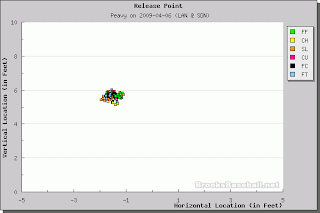
Notice the significantly tighter release groupings in this image.

These are the results of an inconsistent release point. Pitches that don't end up where you want them. Small, almost imperceptible differences out of the hand lead to very noticeable differences by the time the ball reaches home plate.

Here it might appear pitches are missing too. But a close look reveals that they're 'missing,' where they're supposed to. The slider is missing middle of the plate, down and away. The only pitch that is consistently 'off' is the fastball which he's locating to set up other pitches.

For the most part, all the pitches are pretty flat. Which is a big reason why hitters are making contact with over 84% of his pitches they swing at this season, vs around 75% for his career.

Here you can see how much better the movement of Peavy's pitches was. Particularly with his slider which faded hard from the swing of left-handers, and the slider which dove from right-handers. Those out pitches were keys for him, and this year, they just aren't there.
So there you have it. Jake Peavy is out of whack.
His command is being affected by his inability to find consistent release points, and his movement is nowhere to be found.
You can see the results in the stats, the increased fly ball and walk rates, the decreased strikeout rates. But the charts confirm that it's not just early season bad luck. Jake Peavy is a noticeably different pitcher than he is when he's on and it's likely going to take more than just a little tinkering for him to get back on track.
That's bad news for the White Sox who were going to be relying on him heavily in 2010 to contend.
After watching him throw 20 innings of three run baseball at the end of the year last season, many of those concerns should've been allayed. The innings were good at just under seven per start and the ancillary stats: 18K, 6BB, 1HR were strong as well.
This season the results have been much worse, and I'm concerned that it isn't going to get better any time soon. First, the numbers;
4GS / 22.1 IP / 26H / 15BB / 15K / 3HBP / 3HR
The numbers aren't off in just one area, they're off everywhere. All the good numbers, strikeouts, innings pitched, are down. And the bad ones, walks, home runs, hit batters, are way up.
Generally speaking you write off early season performances because the sample sizes are too small to matter. But just watching him the past couple games, he look different than he did when I watched him a couple seasons ago. However, knowing that you can't usually trust your eyes, I decided to take a look at his PitchFX data to see if he was actually doing anything differently.
I'll be looking at the data from his last start (4/22/10) vs a start where he was going well back in 2009 (4/6/09 vs the Dodgers), before he torn the tendon in his ankle.
Well put the charts next to each other so you can see what Good Peavy and Bad Peavy look like side by side.

Notice the significantly tighter release groupings in this image.

These are the results of an inconsistent release point. Pitches that don't end up where you want them. Small, almost imperceptible differences out of the hand lead to very noticeable differences by the time the ball reaches home plate.
Here it might appear pitches are missing too. But a close look reveals that they're 'missing,' where they're supposed to. The slider is missing middle of the plate, down and away. The only pitch that is consistently 'off' is the fastball which he's locating to set up other pitches.
For the most part, all the pitches are pretty flat. Which is a big reason why hitters are making contact with over 84% of his pitches they swing at this season, vs around 75% for his career.
Here you can see how much better the movement of Peavy's pitches was. Particularly with his slider which faded hard from the swing of left-handers, and the slider which dove from right-handers. Those out pitches were keys for him, and this year, they just aren't there.
So there you have it. Jake Peavy is out of whack.
His command is being affected by his inability to find consistent release points, and his movement is nowhere to be found.
You can see the results in the stats, the increased fly ball and walk rates, the decreased strikeout rates. But the charts confirm that it's not just early season bad luck. Jake Peavy is a noticeably different pitcher than he is when he's on and it's likely going to take more than just a little tinkering for him to get back on track.
That's bad news for the White Sox who were going to be relying on him heavily in 2010 to contend.
Monday, April 5, 2010
What should the White Sox do about Paul Konerko?
One of the biggest challenges that will face White Sox GM Kenny Williams this off season will be what exactly to do about the teams first base situation. The White Sox have had the luxury of riding the powerful right handed bat of Paul Konerko since acquiring him in 1999 for center fielder Mike Cameron. Since coming to Chiacgo, Konerko has been a consistent offensive force, powering the team to multiple playoff births and helping to secure the World Series for the franchise in 2005.
Konerko however, is no spring chicken. By the time the 2011 season rolls around Konerko will be 35. One of the main tenets of managing a small-mid payroll team is that teams need to be very careful when handing money out to aging veterans. The team must also consider the potential side effects of letting a fan favorite and team captain leave. I'm not much for intangibles, but Konerko has been the heart and soul of the franchise for a long time and letting him walk would undeniably change the dynamic inside the clubhouse.
On a pure statistical level, Konerko hasn't been an elite hitter since 2006, and given his age it's unlikely he will be again. In 2009 the MLB average OPS for first basemen was .845 - Konerko posted a .841 mark - his highest since '06, making him just slightly below average offensively. According to UZR he's been right around league average defensively his entire career, posting a +3.2 mark last year. In terms of WAR, he's posted his best mark of the past three season last year with a +2.7. Over the past three seasons however he's averaged just +1.93 wins above replacement.
On the free agent market, a player is worth about 4.5m per win above average. Using that rough estimate as a guideline, Konerko would typically be worth ~8-10m per season on the free agent market. However as we've seen the past couple years, the market for aging corner infielders/outfielders has been greatly depressed. Teams, it would seem, are coming to realize the relative ease with which these players can be replaced. As said earlier of course, the White Sox stand to lose a bit more than just Konerko's production.
With all the factors; offense, defense, intangibles, and corner infielder market value on the table, what would a fair offer be? I don't think it would be the 8-10m per annum our basic WAR extrapolation would suggest. That's primarily because there will be perhaps a half-dozen capable first basemen on the market next year. Just running down the list of guys who are probably worthy of starting jobs (in no particular order);
Adam Dunn, Nick Johnson, Adam LaRoche, Derrek Lee, Carlos Pena, and of course, Konerko. Technically Albert Pujols and Lance Berkman could be free agents as well, but I'd imagine their respective teams will be exercising their options. Beyond those players, there will be as many as a dozen others looking for work.
Of course, between today and opening day next year some of those players will be resigned, others will be traded. But either way, there will be precious few seats available in the game of musical chairs that is Major League free agency.
Without a clear 1st base propsect pegged to replace Konerko at first, should Williams decide to make resigning Konerko a priority, perhaps a 2 year deal at 7m per season with a team option for a third year at 5m would be fair. Konerko gets a bit of financial security, and the White Sox gain some small measure of protection against further regression. Frankly there are few places I can see Konerko slotting in elsewhere - Atlanta being the primary location to me. But even then, I can't see him getting more than the offer above.
The White Sox could try and go lower than that of course and try and pinch Konerko - and it might work. But I'm also the sort of person who believes that if you're going to keep a player like Konerko, you should do your best to treat him as fairly as possible.
Should Williams decide NOT to resign Konerko, as you can see there will be plenty of other options available to him in free agency. Newly acquired Jake Peavy of course, has lobbied to bring over former San Diego teammate and superstar Adrian Gonzalez. That of course is a whole other conversation for a different day. But the point stands - there will be no shortage of options via free agency or trade.
If none of those options are viable, could the White Sox choose to shift Carlos Quentin out of the outfield and over to first base? People always kick around talk of players moving positions, and generally it's foolishness, but there have been plenty of range-limited corner outfielders who've made the switch, so it isn't out of the question.
There is no shortage of options available to Kenny Williams and it'll be interesting as always to see how he plays his hand.
Konerko however, is no spring chicken. By the time the 2011 season rolls around Konerko will be 35. One of the main tenets of managing a small-mid payroll team is that teams need to be very careful when handing money out to aging veterans. The team must also consider the potential side effects of letting a fan favorite and team captain leave. I'm not much for intangibles, but Konerko has been the heart and soul of the franchise for a long time and letting him walk would undeniably change the dynamic inside the clubhouse.
On a pure statistical level, Konerko hasn't been an elite hitter since 2006, and given his age it's unlikely he will be again. In 2009 the MLB average OPS for first basemen was .845 - Konerko posted a .841 mark - his highest since '06, making him just slightly below average offensively. According to UZR he's been right around league average defensively his entire career, posting a +3.2 mark last year. In terms of WAR, he's posted his best mark of the past three season last year with a +2.7. Over the past three seasons however he's averaged just +1.93 wins above replacement.
On the free agent market, a player is worth about 4.5m per win above average. Using that rough estimate as a guideline, Konerko would typically be worth ~8-10m per season on the free agent market. However as we've seen the past couple years, the market for aging corner infielders/outfielders has been greatly depressed. Teams, it would seem, are coming to realize the relative ease with which these players can be replaced. As said earlier of course, the White Sox stand to lose a bit more than just Konerko's production.
With all the factors; offense, defense, intangibles, and corner infielder market value on the table, what would a fair offer be? I don't think it would be the 8-10m per annum our basic WAR extrapolation would suggest. That's primarily because there will be perhaps a half-dozen capable first basemen on the market next year. Just running down the list of guys who are probably worthy of starting jobs (in no particular order);
Adam Dunn, Nick Johnson, Adam LaRoche, Derrek Lee, Carlos Pena, and of course, Konerko. Technically Albert Pujols and Lance Berkman could be free agents as well, but I'd imagine their respective teams will be exercising their options. Beyond those players, there will be as many as a dozen others looking for work.
Of course, between today and opening day next year some of those players will be resigned, others will be traded. But either way, there will be precious few seats available in the game of musical chairs that is Major League free agency.
Without a clear 1st base propsect pegged to replace Konerko at first, should Williams decide to make resigning Konerko a priority, perhaps a 2 year deal at 7m per season with a team option for a third year at 5m would be fair. Konerko gets a bit of financial security, and the White Sox gain some small measure of protection against further regression. Frankly there are few places I can see Konerko slotting in elsewhere - Atlanta being the primary location to me. But even then, I can't see him getting more than the offer above.
The White Sox could try and go lower than that of course and try and pinch Konerko - and it might work. But I'm also the sort of person who believes that if you're going to keep a player like Konerko, you should do your best to treat him as fairly as possible.
Should Williams decide NOT to resign Konerko, as you can see there will be plenty of other options available to him in free agency. Newly acquired Jake Peavy of course, has lobbied to bring over former San Diego teammate and superstar Adrian Gonzalez. That of course is a whole other conversation for a different day. But the point stands - there will be no shortage of options via free agency or trade.
If none of those options are viable, could the White Sox choose to shift Carlos Quentin out of the outfield and over to first base? People always kick around talk of players moving positions, and generally it's foolishness, but there have been plenty of range-limited corner outfielders who've made the switch, so it isn't out of the question.
There is no shortage of options available to Kenny Williams and it'll be interesting as always to see how he plays his hand.
Friday, April 2, 2010
Bounce Back Players
In the race for AL Central supremacy, the fate of the three front runners - the Twins, Tigers, and White Sox - could very likely rest on the shoulders of a handful of players looking to come back strong. Today we'll examine which players fans of those team should expect to come back, and which are likely to disappoint.
Tigers
Magglio Ordonez: Ordonez was hardly useless last year, posting a solid .804 OPS. But for a guy who has a career OPS of of .884, that's not quite what Tigers fans have come to expect. The primary reason for the decline a big decline in the power department. After raking 55 extra base hits in 2009, he had just 35 last year - just nine of which were home runs. More troubling still, it wasn't the first year of decline - he had an absurd 82 extra base hits in 2008.
For a guy who will be 36 this year, the days of posting MVP numbers are likely behind Magglio, but there is plenty of evidence to suggest that he should rebound nicely this year and be more like the hitter he was in 2008, than the guy he was in 2009.
First and most importantly, while there was a significant decline in power production, there wasn't much change in Ordonez' ancillary numbers. His strikeout, walks, and line drive rates remain essentially unchanged. The one huge difference was in ground ball rate. Magglio, as is the case with most power hitters, has always been an extreme fly ball hitter. Last year that changed radically as his ground ball rate shot up to 51% from a career rate of 44.2%.
To me, that suggests a mechanical issue, and mechanical issues can be fixed with good coaching. I'd be far more concerned if we were seeing declines in the other numbers, as that would suggest lower bat speed, or declining ability to recognize and react to pitches. We don't see any of that. With a fine spring training under his belt where he mashed six extra base hits along with a pair of homers in just 51 at-bats, I'd expect Magglio to produce just fine in the middle of the Tigers order and provide a lot more run producing power to a lineup I think will surprise a lot of people in 2009.
Dontrelle Willis: After being left by the side of the road for garbage removal, Willis has seemingly risen from the dead to reclaim a spot in the Tigers rotation. The Tigers front office clearly felt strong enough about Willis that they we're willing to trade Nate Robertson to the Marlins. Robertson having plenty of his own issues and his own bloated contract obviously convolutes the impressiveness of Willis' feat, but given where he has been the last couple years, this should be seen as a very good sign.
When most people think of Willis, they tend to remember him as the dominant youngster he was with the Marlins back in the early part of the decade. The weird thing is that despite some gaudy ERA and W/L numbers, he was never really that terribly dominant. His fastball velocity at it's peak only averaged 90.5 mph, he only once topped 7 K/9, only once had a walk rate lower than 2.7 BB/9, and has only once had a ground ball rate over 50%. Of all the things pitchers generally need to do well in order to be successful, Willis hasn't really ever done any of them.
To me that means he was getting by on deception, whether it was the crazy leg kick or the weird 3/4, almost sidearm slot he used to throw with. Either way, hitters figured him out. When they did, it left a lot of people feeling confused, but really, there was never much to be confused by. Willis, was, and always has been, a pretty mediocre pitcher. The problem is that beginning in 2006, his walk rate began to deteriorate. It was somewhat steady at first, but his command fell off a cliff after joining the Tigers and since signing a huge contract with the team, he's made just 14 starts in two seasons, with a combined ERA over 8.00.
Things might be looking up for Willis and the Tigers however. Reports this spring are that Willis is throwing in the high 80's, which is just a bit lower than his career norms, and that he's gotten his command issues under control enough to be useful.
I however, remain highly skeptical. While reports of better command are nice, 12 walks in 19.1 spring innings against just 13 strikeouts doesn't bode well at all. While one should never look into spring training innings much at all, in Willis' case, you almost have to. One thing Willis has done a phenomenal job of however, is keeping the ball on the ground, getting 2 ground ball outs for every fly out this spring.
On a personal level, I want Willis to succeed. I've followed his decline pretty closely since his days with the Marlins and remember what a great ambassador for the game he seemed to be. Willis was the sort of player it was difficult to root against, and that remains true to this day. He's always struck me as a pretty humble guy, and to read some of the quotes from him when he was down was just sad. Unfortunately, I also have to listen to my common sense, and on the whole, I don't expect much from Willis this year and I'm afraid he'll be out of the rotation within a month.
White Sox
Alex Rios: Earlier, in discussing Magglio Ordonez, I pointed out how I would be concerned to see a player posting declining numbers in their strikeout, walk, and line drive rates. I used that to illustrate why I expected Magglio Ordonez to have a return to normalcy this season. Well, it is for precisely those same reasons that I am more concerned about Rios.
Even after wasting his first two seasons with OPS numbers in the low .700s and a disastrous 2009, Rios has been a career .289/.330/.444 hitter. He posted back-to-back .850+ OPS seasons in 2006 and 2007 and a solid if unspectacular .798 in 2008. So even with three really ugly seasons in his short career, he's been at least a league average offensive player.
That said, all the trend lines for Rios are going the wrong way. His ISO (isolated power) has decline in four straight seasons, and his strikeout and walk rates have trended the wrong way for three straight seasons. His line drive rate, pretty consistently at around 20% for his career nose dived to 16.4% last year.
Those numbers definitely suggest a player who's skill set is diminishing. He simply doesn't seem to be seeing the ball as well, and is no longer able to square it up the way he once was. There is evidence that he may have been able to mask his decline to some extent in 2008 by posting a .337 BABIP, his highest mark ever and 12 points above his career average, though the .798 OPS should've provided some evidence to his lessening skills. Last year however, he was definitely the victim of some bad luck as his BABIP was just .273.
While the trend lines suggest that his decline is real, and his BABIP last year suggests he was unlucky, I personally tend to trust the trend lines more. Even if Rios' BABIP last year was in like with his career average, of .319, which would've added a substantial 36 points to his batting average, 2009 still would've ranked as his worst season since 2005.
I'm confident that Rios will rebound to some extent in 2010, but I'm also confident that his days of being a .800 OPS hitter are likely over. Given the contact commitment the White Sox are on the hook for with him, that could be a very bad thing indeed. Generally speaking Kenny Williams is one of the savviest GMs in baseball, but I think he may have miscalculated this move. Hopefully for the White Sox faithful, I'm wrong.
Jake Peavy: Clearly this is less a conversation about some kind of decline that Peavy had, and more about his return from injury, but there is one possible sign of decline in Peavy too. Most prominently I'm referring to his walk rate. While they're hardly been bad the past couple of years, they aren't what they once were either. From 2004 through 2007, a stretch of four seasons, the WORST walk rate Peavy ever posted was 2.87 BB/9.
While nit-picking on a slightly worse walk rate than normal might be considered reaching, it is worth being aware of. We should also take note of slight decreases in velocity the past couple of seasons. While velocity tends to be over-valued by fans and research shows the difference between fastballs with equal movement and location tend to be almost exactly as effective regardless of the speed with which the pitch is thrown - the exceptions being above 96 mph or below 85 mph - declining velocity does frequently (though hardly always) correlate with declining overall skills.
The good news for Sox fans is that Peavy was dominant in his return last fall. While the strikeout rates were predictably off just a little bit, the walk rate looked good and he kept the ball in the ballpark nicely. He's had some command issues this spring, and while there has been some hand wringing in the media, I'm inclined to believe it's nothing.
I expect big things from Peavy this year, and if he can return to his Cy Young winning form, he could just lead the White Sox to the playoffs.
Carlos Quentin: Much like Peavy, Quentin struggled through an injury plagued 2009 season, but when he's on and when he's healthy he's be a legitimate force in the middle of any lineup. Given the trade of Jim Thome and the off season departure of Jermaine Dye, Quentin will be expected to provide much of the punch in the middle of the Chicago offense.
If Quentin can provide anything like the .965 OPS he did in 2008, it's going to make the White Sox a much tougher team to contend with. Standing in Quentin's way will be an off walk rate, historically poor line drive rates, and increasing fly ball rates.
High fly ball rates and poor line drive rates will pretty much always coincide with below normal BABIP numbers, and Quentin is no exception. If his career BABIP of .255 seems freakishly low, that's because it is. It also means his BABIP of .282 in 2008 suggested he was a bit lucky that year, and a bit unlucky last season. I'm expecting something in the neighborhood of a .860-.880 OPS this year.
Twins
J.J. Hardy: Hardy was acquired by the Twins in a trade for Carlos Gomez. It was a good trade in the sense that each team was trading from a position of strength to fill a position of weakness. In the Twins case, they had Denard Span to take over for the offensively challenged Gomez, and the Brewers had top prospect Alcides Escobar ready to take over for declining incumbent Hardy.
Like Rios, who I discussed earlier in this post, Hardy has a lot of negative trend lines that don't bode well for future success. The strikeout rate has risen for three straight years to 20.5% this last year, and his line drive rate has fallen for three straight seasons to an almost impossibly low 13.9% last year. His power also fell off a cliff from a career high ISO of .195 in 2008 to .128 last year. Furthermore a study of his BABIP last year leads one to believe luck wasn't a huge factor last year as his .260 mark wasn't too far off his career .278.
If there was any sign of hope for Hardy last year it was that his walk rate was the best of his career. The Twins won't be relying Hardy to power their offense by any means, and right now it looks like he'll be slotted 7th or 8th in the order. All the same, Hardy was brought in with the intent of shoring up the incredibly weak offense the team received at shortstop and second base last year, and with a 5.1m payroll number, he'll be expected to provide something for the team with the bat.
Thankfully to say, much of Hardy's value is tied up in the fact that he's a plus defender at a defense first position, and that did not take a step backward last season. It'll be interesting to see how the move to the AL effects Hardy - generally that doesn't bode well for the player - if that trend holds true and Hardy isn't able to regain his old offensive form, Bill Smith will have missed once again in a trade.
Everything having been said, I'm not too high on Hardy and I don't expect much of a bounce back season, though he shouldn't be quite as bad as last year. If he can give the Twins an OPS around .750, Twins fans should consider themselves lucky.
Francisco Liriano: After what can only be described as a dismal 2009, many Twins fans seemed ready to give up on Liriano. There was talk of moving him to the bullpen permanently, or trading him for whatever they could get. Thankfully for the Twins, that didn't happen. Instead Liriano headed off off to the Dominican Winter League and dominated. He then came to spring training and picked up where he left off. Between the Dominican League and the Cactus League he gave his teams 68.2 innings of shut-down baseball. In that span he struck out 97, walked 7, and allowed just two home runs.
Obviously those video game type numbers aren't going to carry over to the Majors, but the Twins and their fans have every reason to be excited. Perhaps most importantly, this is one of those situations where the numbers and the reports jive. Scouts have been saying that Liriano has regained more of his velocity, not all of it, but enough to make a difference. More importantly, his slider, once one of baseballs most devastating pitches, is breaking harder and deeper with more consistency than it has since 2006.
Right now Liriano is projected to be the Twins 5th starter but I have a feeling he's going to end up as their ace by the time May comes around. Either way, he should be significantly better than he was in 2009, and I think his downside might be his 2008 second half which was pretty solid in its own right. If Liriano can return to being a #1 or #2 - or even a #3 he's going to make a big difference in the outcome of the Twins 2010 season.
Tigers
Magglio Ordonez: Ordonez was hardly useless last year, posting a solid .804 OPS. But for a guy who has a career OPS of of .884, that's not quite what Tigers fans have come to expect. The primary reason for the decline a big decline in the power department. After raking 55 extra base hits in 2009, he had just 35 last year - just nine of which were home runs. More troubling still, it wasn't the first year of decline - he had an absurd 82 extra base hits in 2008.
For a guy who will be 36 this year, the days of posting MVP numbers are likely behind Magglio, but there is plenty of evidence to suggest that he should rebound nicely this year and be more like the hitter he was in 2008, than the guy he was in 2009.
First and most importantly, while there was a significant decline in power production, there wasn't much change in Ordonez' ancillary numbers. His strikeout, walks, and line drive rates remain essentially unchanged. The one huge difference was in ground ball rate. Magglio, as is the case with most power hitters, has always been an extreme fly ball hitter. Last year that changed radically as his ground ball rate shot up to 51% from a career rate of 44.2%.
To me, that suggests a mechanical issue, and mechanical issues can be fixed with good coaching. I'd be far more concerned if we were seeing declines in the other numbers, as that would suggest lower bat speed, or declining ability to recognize and react to pitches. We don't see any of that. With a fine spring training under his belt where he mashed six extra base hits along with a pair of homers in just 51 at-bats, I'd expect Magglio to produce just fine in the middle of the Tigers order and provide a lot more run producing power to a lineup I think will surprise a lot of people in 2009.
Dontrelle Willis: After being left by the side of the road for garbage removal, Willis has seemingly risen from the dead to reclaim a spot in the Tigers rotation. The Tigers front office clearly felt strong enough about Willis that they we're willing to trade Nate Robertson to the Marlins. Robertson having plenty of his own issues and his own bloated contract obviously convolutes the impressiveness of Willis' feat, but given where he has been the last couple years, this should be seen as a very good sign.
When most people think of Willis, they tend to remember him as the dominant youngster he was with the Marlins back in the early part of the decade. The weird thing is that despite some gaudy ERA and W/L numbers, he was never really that terribly dominant. His fastball velocity at it's peak only averaged 90.5 mph, he only once topped 7 K/9, only once had a walk rate lower than 2.7 BB/9, and has only once had a ground ball rate over 50%. Of all the things pitchers generally need to do well in order to be successful, Willis hasn't really ever done any of them.
To me that means he was getting by on deception, whether it was the crazy leg kick or the weird 3/4, almost sidearm slot he used to throw with. Either way, hitters figured him out. When they did, it left a lot of people feeling confused, but really, there was never much to be confused by. Willis, was, and always has been, a pretty mediocre pitcher. The problem is that beginning in 2006, his walk rate began to deteriorate. It was somewhat steady at first, but his command fell off a cliff after joining the Tigers and since signing a huge contract with the team, he's made just 14 starts in two seasons, with a combined ERA over 8.00.
Things might be looking up for Willis and the Tigers however. Reports this spring are that Willis is throwing in the high 80's, which is just a bit lower than his career norms, and that he's gotten his command issues under control enough to be useful.
I however, remain highly skeptical. While reports of better command are nice, 12 walks in 19.1 spring innings against just 13 strikeouts doesn't bode well at all. While one should never look into spring training innings much at all, in Willis' case, you almost have to. One thing Willis has done a phenomenal job of however, is keeping the ball on the ground, getting 2 ground ball outs for every fly out this spring.
On a personal level, I want Willis to succeed. I've followed his decline pretty closely since his days with the Marlins and remember what a great ambassador for the game he seemed to be. Willis was the sort of player it was difficult to root against, and that remains true to this day. He's always struck me as a pretty humble guy, and to read some of the quotes from him when he was down was just sad. Unfortunately, I also have to listen to my common sense, and on the whole, I don't expect much from Willis this year and I'm afraid he'll be out of the rotation within a month.
White Sox
Alex Rios: Earlier, in discussing Magglio Ordonez, I pointed out how I would be concerned to see a player posting declining numbers in their strikeout, walk, and line drive rates. I used that to illustrate why I expected Magglio Ordonez to have a return to normalcy this season. Well, it is for precisely those same reasons that I am more concerned about Rios.
Even after wasting his first two seasons with OPS numbers in the low .700s and a disastrous 2009, Rios has been a career .289/.330/.444 hitter. He posted back-to-back .850+ OPS seasons in 2006 and 2007 and a solid if unspectacular .798 in 2008. So even with three really ugly seasons in his short career, he's been at least a league average offensive player.
That said, all the trend lines for Rios are going the wrong way. His ISO (isolated power) has decline in four straight seasons, and his strikeout and walk rates have trended the wrong way for three straight seasons. His line drive rate, pretty consistently at around 20% for his career nose dived to 16.4% last year.
Those numbers definitely suggest a player who's skill set is diminishing. He simply doesn't seem to be seeing the ball as well, and is no longer able to square it up the way he once was. There is evidence that he may have been able to mask his decline to some extent in 2008 by posting a .337 BABIP, his highest mark ever and 12 points above his career average, though the .798 OPS should've provided some evidence to his lessening skills. Last year however, he was definitely the victim of some bad luck as his BABIP was just .273.
While the trend lines suggest that his decline is real, and his BABIP last year suggests he was unlucky, I personally tend to trust the trend lines more. Even if Rios' BABIP last year was in like with his career average, of .319, which would've added a substantial 36 points to his batting average, 2009 still would've ranked as his worst season since 2005.
I'm confident that Rios will rebound to some extent in 2010, but I'm also confident that his days of being a .800 OPS hitter are likely over. Given the contact commitment the White Sox are on the hook for with him, that could be a very bad thing indeed. Generally speaking Kenny Williams is one of the savviest GMs in baseball, but I think he may have miscalculated this move. Hopefully for the White Sox faithful, I'm wrong.
Jake Peavy: Clearly this is less a conversation about some kind of decline that Peavy had, and more about his return from injury, but there is one possible sign of decline in Peavy too. Most prominently I'm referring to his walk rate. While they're hardly been bad the past couple of years, they aren't what they once were either. From 2004 through 2007, a stretch of four seasons, the WORST walk rate Peavy ever posted was 2.87 BB/9.
While nit-picking on a slightly worse walk rate than normal might be considered reaching, it is worth being aware of. We should also take note of slight decreases in velocity the past couple of seasons. While velocity tends to be over-valued by fans and research shows the difference between fastballs with equal movement and location tend to be almost exactly as effective regardless of the speed with which the pitch is thrown - the exceptions being above 96 mph or below 85 mph - declining velocity does frequently (though hardly always) correlate with declining overall skills.
The good news for Sox fans is that Peavy was dominant in his return last fall. While the strikeout rates were predictably off just a little bit, the walk rate looked good and he kept the ball in the ballpark nicely. He's had some command issues this spring, and while there has been some hand wringing in the media, I'm inclined to believe it's nothing.
I expect big things from Peavy this year, and if he can return to his Cy Young winning form, he could just lead the White Sox to the playoffs.
Carlos Quentin: Much like Peavy, Quentin struggled through an injury plagued 2009 season, but when he's on and when he's healthy he's be a legitimate force in the middle of any lineup. Given the trade of Jim Thome and the off season departure of Jermaine Dye, Quentin will be expected to provide much of the punch in the middle of the Chicago offense.
If Quentin can provide anything like the .965 OPS he did in 2008, it's going to make the White Sox a much tougher team to contend with. Standing in Quentin's way will be an off walk rate, historically poor line drive rates, and increasing fly ball rates.
High fly ball rates and poor line drive rates will pretty much always coincide with below normal BABIP numbers, and Quentin is no exception. If his career BABIP of .255 seems freakishly low, that's because it is. It also means his BABIP of .282 in 2008 suggested he was a bit lucky that year, and a bit unlucky last season. I'm expecting something in the neighborhood of a .860-.880 OPS this year.
Twins
J.J. Hardy: Hardy was acquired by the Twins in a trade for Carlos Gomez. It was a good trade in the sense that each team was trading from a position of strength to fill a position of weakness. In the Twins case, they had Denard Span to take over for the offensively challenged Gomez, and the Brewers had top prospect Alcides Escobar ready to take over for declining incumbent Hardy.
Like Rios, who I discussed earlier in this post, Hardy has a lot of negative trend lines that don't bode well for future success. The strikeout rate has risen for three straight years to 20.5% this last year, and his line drive rate has fallen for three straight seasons to an almost impossibly low 13.9% last year. His power also fell off a cliff from a career high ISO of .195 in 2008 to .128 last year. Furthermore a study of his BABIP last year leads one to believe luck wasn't a huge factor last year as his .260 mark wasn't too far off his career .278.
If there was any sign of hope for Hardy last year it was that his walk rate was the best of his career. The Twins won't be relying Hardy to power their offense by any means, and right now it looks like he'll be slotted 7th or 8th in the order. All the same, Hardy was brought in with the intent of shoring up the incredibly weak offense the team received at shortstop and second base last year, and with a 5.1m payroll number, he'll be expected to provide something for the team with the bat.
Thankfully to say, much of Hardy's value is tied up in the fact that he's a plus defender at a defense first position, and that did not take a step backward last season. It'll be interesting to see how the move to the AL effects Hardy - generally that doesn't bode well for the player - if that trend holds true and Hardy isn't able to regain his old offensive form, Bill Smith will have missed once again in a trade.
Everything having been said, I'm not too high on Hardy and I don't expect much of a bounce back season, though he shouldn't be quite as bad as last year. If he can give the Twins an OPS around .750, Twins fans should consider themselves lucky.
Francisco Liriano: After what can only be described as a dismal 2009, many Twins fans seemed ready to give up on Liriano. There was talk of moving him to the bullpen permanently, or trading him for whatever they could get. Thankfully for the Twins, that didn't happen. Instead Liriano headed off off to the Dominican Winter League and dominated. He then came to spring training and picked up where he left off. Between the Dominican League and the Cactus League he gave his teams 68.2 innings of shut-down baseball. In that span he struck out 97, walked 7, and allowed just two home runs.
Obviously those video game type numbers aren't going to carry over to the Majors, but the Twins and their fans have every reason to be excited. Perhaps most importantly, this is one of those situations where the numbers and the reports jive. Scouts have been saying that Liriano has regained more of his velocity, not all of it, but enough to make a difference. More importantly, his slider, once one of baseballs most devastating pitches, is breaking harder and deeper with more consistency than it has since 2006.
Right now Liriano is projected to be the Twins 5th starter but I have a feeling he's going to end up as their ace by the time May comes around. Either way, he should be significantly better than he was in 2009, and I think his downside might be his 2008 second half which was pretty solid in its own right. If Liriano can return to being a #1 or #2 - or even a #3 he's going to make a big difference in the outcome of the Twins 2010 season.
Subscribe to:
Posts (Atom)